

Natural vs. Synthetic Fragrance Oils: What Every Candle and Soap Maker Needs to Know
Choosing a fragrance oil is one of the most consequential decisions you'll make as a maker. The scent defines the finished product—whether it's a hand-poured soy candle, a cold-process soap bar, or a whipped body butter. But the term fragrance oil actually covers two very different categories: natural fragrance oils and synthetic fragrance oils. Understanding the distinctions between them helps you pick the right option for your project, your brand story, and your customers.
What Are Fragrance Oils, Exactly?
At the broadest level, fragrance oils are concentrated aromatic liquids formulated for use in candles, soaps, perfumes, and body-care products. They are distinct from pure essential oils, which are extracted directly from a single plant source. Fragrance oils—whether natural or synthetic—are blended compositions engineered for a specific scent profile.
Fragrance oils are composed of a blend of synthetic aromatic compounds and natural components, and they offer a wide range of scents commonly used in candles, soaps, perfumes, and other scented products. They are known for consistent and long-lasting fragrance, which makes them popular for both commercial and homemade products.
Natural Fragrance Oils: Sourced from Botanicals
How They're Made
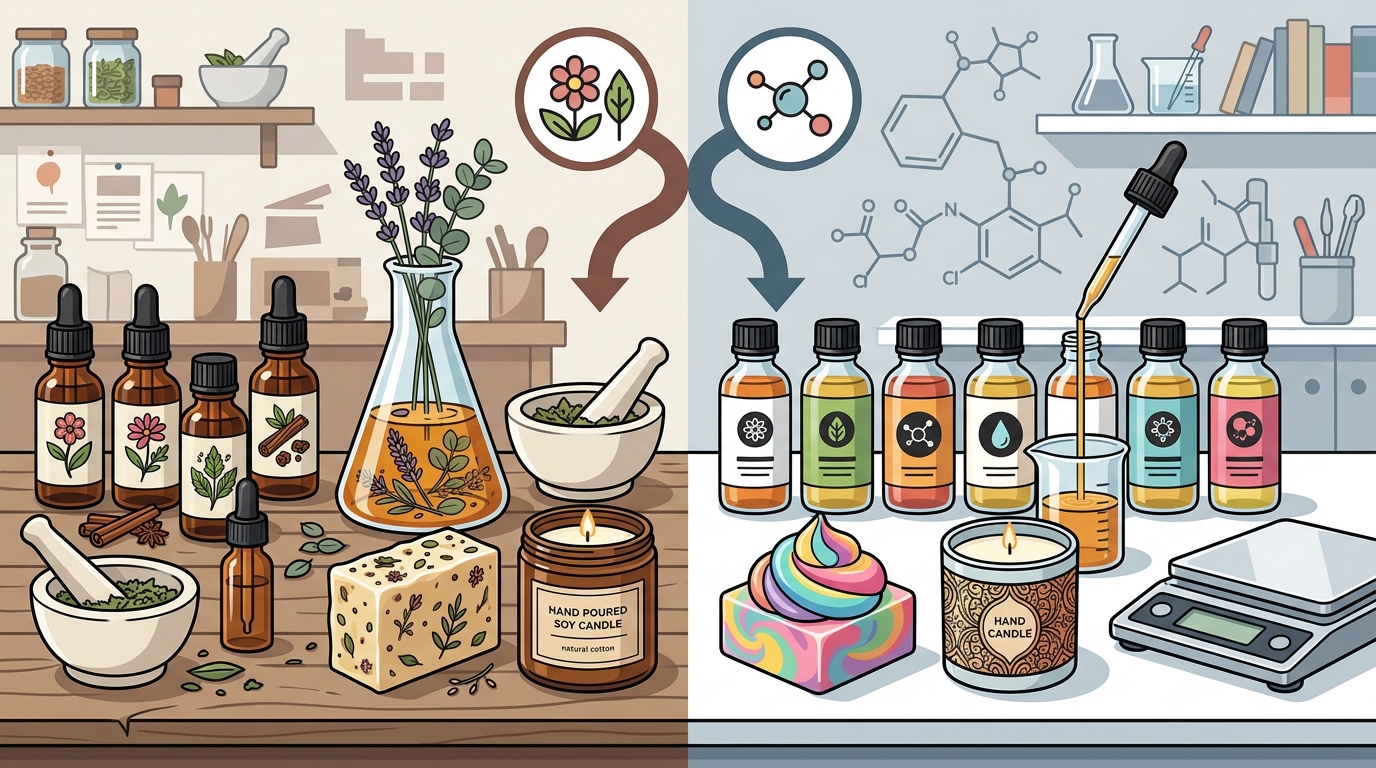
Natural fragrance oils are not the same thing as essential oils. They are formulated in a laboratory, but every ingredient is derived from a natural, botanical source. The building blocks include essential oils, absolutes, CO2 extracts, and natural isolates—individual aroma molecules separated from a plant's complex scent profile.
For example, Bulgarian lavender contains components such as linalyl acetate, linalool, β-caryophyllene, and terpinen-4-ol. To create a natural fragrance oil, one of those components would be isolated from the plant. These single aromatic chemicals are called isolates, and they carry an ISO 9235 designation, meaning they are classified as natural by the International Organization for Standardization. Those isolates are then blended with others from a variety of different plants to build a target scent.
Strengths of Natural Fragrance Oils
- Clean-label appeal: If your brand centres on transparency and plant-based ingredients, natural fragrance oils let you offer scents that go beyond basic essential-oil profiles without resorting to synthetic chemistry.
- Broader scent palette than essential oils alone: Natural fragrance oils are made from plants, but they offer more scent variety than essential oils because isolates from many different botanicals can be recombined.
- Skincare performance: Many formulators find natural fragrance oils shine in skincare products like serums, balms, masks, and moisturisers.
Limitations to Be Aware Of
- Scent fading in soap: One well-documented limitation is that natural fragrance oils can lose their scent during the cure phase of cold-process soap. Many natural fragrances fade away to nothing during curing, so they are generally not recommended for CP soap, although some heavier profiles survive.
- Lighter throw: Natural oils can have a lighter aroma because they are derived from real plant components rather than artificial enhancers. In candle making, that may mean a higher usage rate is required.
- Batch variation: Because ingredients are sourced from living plants, there will be natural batch variation from one production run to the next.
- Narrower range: Certain plants simply don't produce extractable aromatic compounds. You won't find a natural watermelon or fresh-baked-cookie fragrance oil sourced entirely from nature.
Synthetic Fragrance Oils: Engineered for Performance
How They're Made
Synthetic fragrance oils are created in a lab using aroma chemicals—some derived from petrochemical feed-stocks, others semi-synthetic (chemically modified natural molecules). A single synthetic fragrance oil can be made up of 40 to 80 individual materials, which allows perfumers to build complex blends that cannot always be replicated in nature.
They may also contain solvents, stabilisers, preservatives, and UV inhibitors that help the scent remain consistent over time and across different product matrices.
Strengths of Synthetic Fragrance Oils
- Scent variety is virtually limitless: Because of the use of synthetic ingredients, there are nearly endless possibilities for aromas—from gourmand blends like vanilla cupcake and salted caramel to fantasy florals and ocean breezes that have no botanical equivalent.
- Superior staying power: Synthetic fragrance oils are formulated for longevity. In both candles and soap, they outperform natural options on scent retention and throw.
- Consistency: Every batch is manufactured to the same specification, eliminating the crop-to-crop variability you see with plant-derived ingredients.
- Cost-effectiveness: Some essential oils are extraordinarily expensive. Rose essential oil, for instance, requires thousands of pounds of petals per ounce. A rose fragrance oil delivers a potent, lingering scent at a fraction of the cost.
- Soap-safe: Synthetic fragrance oils work well in all projects, including cold and hot process soap, where natural options may fade.
Limitations to Be Aware Of
- Labelling restrictions: Even though a synthetic fragrance oil may contain some plant-based components, it is still considered synthetic and cannot be listed as natural on a label.
- Consumer perception: Some buyers actively seek products free of synthetic fragrance, so using synthetics can limit your target market if you are branding around an all-natural ethos.
- Potential sensitisers: Reputable suppliers test against IFRA and RIFM standards and exclude known harmful substances. However, lower-quality synthetics from unvetted sources may contain phthalates, benzene derivatives, or Prop 65-listed chemicals. Always request the Safety Data Sheet (SDS) and IFRA certificate before purchasing.
Head-to-Head Comparison Table
| Factor | Natural Fragrance Oils | Synthetic Fragrance Oils |
|---|---|---|
| Source | Plant-derived isolates, essential oils, absolutes, CO2 extracts | Lab-created aroma chemicals, may include some natural components |
| Scent Range | Broad, but limited by available botanicals | Virtually unlimited—gourmand, fantasy, seasonal, and more |
| Consistency | Slight batch variation possible | Highly consistent batch to batch |
| Hot/Cold Throw (Candles) | Moderate; may need higher usage rate | Strong and reliable |
| Cold-Process Soap | Often fades during cure | Excellent scent retention |
| Skincare & Body Care | Excellent—ideal for serums, balms, masks | Good, when skin-safe rated |
| Price | Generally higher | Generally more affordable at scale |
| Label Claims | Can be marketed as natural | Cannot carry a natural label |
| Safety Standards | IFRA / ISO 9235 compliant | IFRA / RIFM compliant |
How Safety Standards Protect You and Your Customers
Regardless of whether you choose natural or synthetic, responsible sourcing matters. Look for fragrance oils that are formulated without phthalates and adhere to RIFM and IFRA standards for safety and purity. The best suppliers also avoid carcinogens, mutagens, and ingredients on the California Prop 65 list.
At makesy, all fragrance oils exclude harmful ingredients such as phthalates, parabens, sulfates, BHT, BHA, PEG, and diacetyl. They are also vegan and cruelty-free. Every product page provides an IFRA certificate so you can verify maximum usage levels for each application—candles, soap, lotion, perfume, and more.
Choosing the Right Type for Your Project
Candle Making
Scent throw—the ability of a candle to fill a room—is paramount. Synthetic fragrance oils are generally preferred here because candle making requires scent stability, longevity, and throw. Synthetic elements create a more reliable, long-lasting fragrance. That said, natural fragrance oils have been tested for hot and cold throw performance in candles and can perform beautifully in wax, especially at slightly higher usage rates.
Synthetic molecules are also intentionally designed to burn cleanly in a candle flame, whereas some natural oils can sometimes produce a burning scent, indicating possible chemical degradation during combustion.
Soap Making
For cold-process soap, synthetic fragrance oils are the safer bet for scent retention. Natural fragrance oils tend to fade as they cure. If you are committed to an all-natural soap line, essential oils are often the more reliable alternative—though even citrus essential oils are known to fade.
For melt-and-pour soap, both natural and synthetic fragrance oils perform well because the base doesn't undergo the long alkaline cure that strips lighter scent molecules.
Skincare, Bath & Body
Natural fragrance oils are superb for skincare products like serums, balms, and moisturisers. Their plant-derived profiles align well with clean-beauty branding, and many formulators appreciate the subtle, true-to-nature character. Synthetic options work too—just ensure they are rated skin-safe and used within IFRA-recommended percentages.
Diffusers, Room Sprays & Incense
Both types work well in home-fragrance applications. Synthetic oils offer stronger throw and wider scent options, while natural oils appeal to consumers who want a plant-based home environment.
Can You Blend Natural and Synthetic Fragrance Oils Together?
Yes. Many professional perfumers combine natural isolates with synthetic aroma chemicals to achieve scent complexity, better performance, and a more attractive price point. If you go this route, keep in mind that the final product can no longer be marketed as all-natural. Always test small batches first, document your ratios in a fragrance journal, and allow the blend to mature so the oils can fuse into a harmonious scent.
The Role of Essential Oils in the Conversation
Essential oils are a third category worth acknowledging. They are entirely natural and are derived from plants through processes like steam distillation or cold-press extraction, capturing the true essence of the plant including its therapeutic properties and aroma. However, they are limited in scent range (no vanilla essential oil exists, for instance, because vanilla beans require a solvent to release their aromatic compounds). Their staying power in finished products also tends to be shorter than either type of fragrance oil.
Natural fragrance oils sit in the middle ground: they are plant-derived like essential oils but offer a wider scent palette, albeit without the therapeutic claims.
Key Takeaways
- Natural fragrance oils are made from plant-derived isolates and essential oils. They are ideal for skincare, clean-label branding, and melt-and-pour soap but may fade in cold-process soap.
- Synthetic fragrance oils are lab-created blends offering superior scent throw, consistency, and variety. They are the standard choice for candle making and cold-process soap.
- Safety is not inherent to either category. Always check for IFRA certificates, SDS sheets, and confirm that oils are free from phthalates, parabens, and Prop 65-listed chemicals.
- Your brand story matters. If you market an all-natural line, natural fragrance oils (or essential oils) are necessary. If performance and scent variety are your priority, synthetic is the way to go.
- Blending the two can give you the best of both worlds—complexity, performance, and interesting natural top notes—but the finished product cannot be labelled natural.
Frequently Asked Questions
Are natural fragrance oils the same as essential oils?
No. Essential oils are extracted directly from a single plant, usually via steam distillation or cold pressing. Natural fragrance oils are blends of natural isolates, essential oils, absolutes, and CO2 extracts from multiple plant sources, combined to create a target scent that may not exist in any single botanical.
Can I use natural fragrance oils in cold-process soap?
You can, but results are often disappointing. Many natural fragrance oils fade significantly during the alkaline curing process. If you want a natural scent in CP soap, pure essential oils (especially woodsy and resinous varieties) tend to hold up better. Synthetic fragrance oils remain the most reliable option for strong, lasting scent in cold-process soap.
Are synthetic fragrance oils safe?
When sourced from reputable suppliers, yes. Look for oils that comply with IFRA and RIFM safety standards and are free from phthalates, parabens, and California Prop 65-listed substances. makesy fragrance oils, for example, exclude phthalates, parabens, sulfates, BHT, BHA, PEG, and diacetyl and are vegan and cruelty-free.
Why do synthetic fragrance oils have a stronger scent throw in candles?
Synthetic aroma chemicals are specifically engineered for volatility and stability in heated wax. They are designed to vaporise at the right temperature and disperse evenly. Natural aromatic molecules were not "designed" for combustion, so some may degrade or burn off unevenly, resulting in weaker throw or off-notes.
What is the recommended fragrance load for candle making?
A common starting point is roughly 1 ounce of fragrance oil per pound of wax, but the ideal load varies depending on wax type, fragrance concentration, and personal preference. Always consult the supplier's recommendations and your IFRA certificate for maximum safe usage levels.
Can I mix natural and synthetic fragrance oils?
Absolutely. Blending the two is a common professional technique to achieve unique scent profiles and better performance. Just remember that the resulting blend cannot be labelled as all-natural, and you should always test in small batches first.