
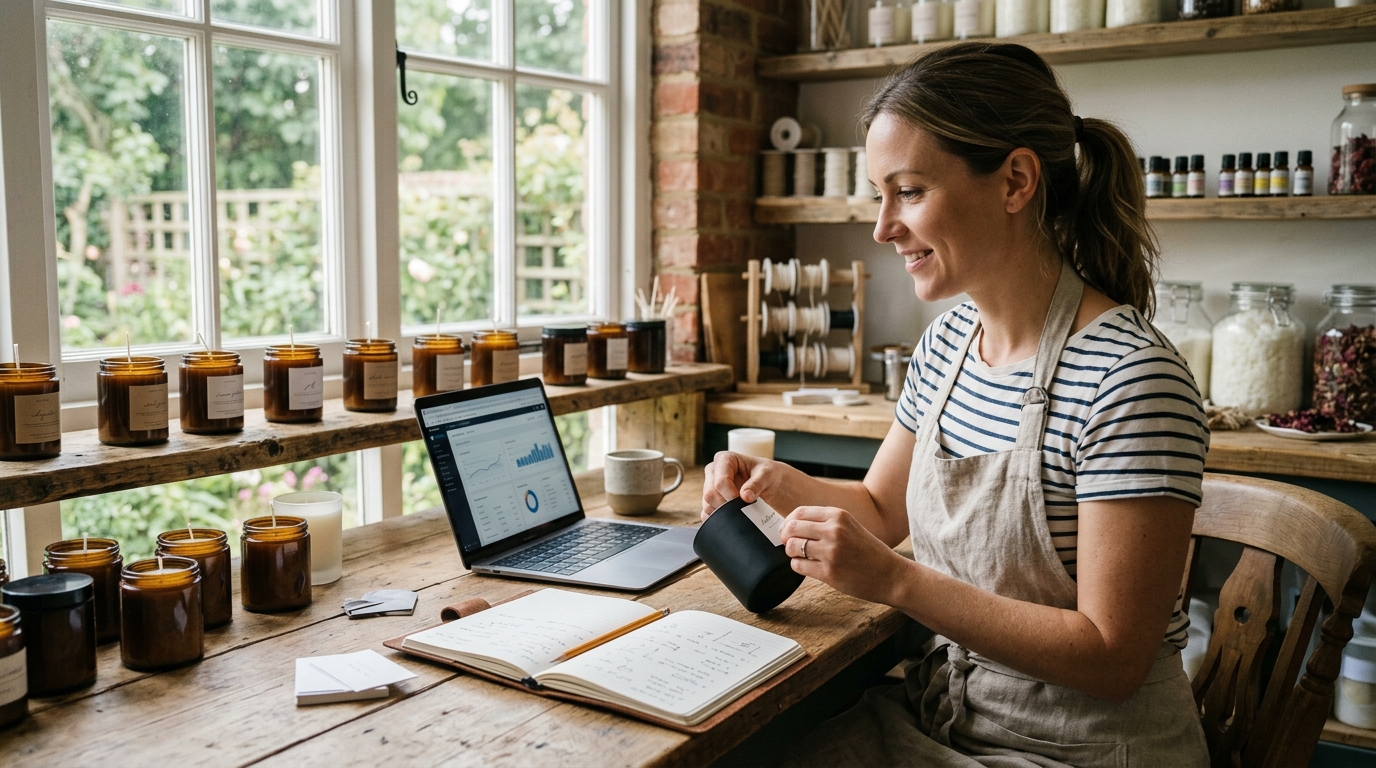
Resources for Turning a Candle Hobby Into a Business
You have been pouring candles for friends and family, perfecting scent blends and testing burn times in your kitchen. Now a familiar thought keeps surfacing: Could I actually sell these? The answer is a confident yes—but the leap from hobby maker to candle entrepreneur requires a clear plan and the right resources at every stage.
This guide walks you through each phase of that transition, from validating your craft and understanding the market to registering legally, pricing for profit, choosing sales channels, and scaling sustainably. Along the way we link to specific tools, suppliers, communities, and educational resources so you can act on every step.
Why the Candle Market Is Worth Entering Right Now
Demand for handmade, artisan candles continues to climb. The global candle market is forecast to grow from $8.98 billion in 2025 to $14.12 billion by 2032, with a compound annual growth rate of 6.69%. Consumers increasingly gravitate toward products that feel thoughtful, handcrafted, and aligned with self-care rituals—and candles sit right at that intersection.
Candle making is also one of the most accessible creative businesses to start. With rising demand for artisan and eco-friendly products, it represents a low-barrier entry point into entrepreneurship. You can begin at the kitchen-bench level with a modest budget, then refine, test, and grow your investment as sales validate your idea.
Phase 1 — Validate Your Craft Before You Sell
The 84 Candle Rule
Before investing in branding, packaging, and an online store, make sure your product is truly business-ready. A practical framework gaining popularity in the maker community is the 84 Candle Rule: create 84 candles and give most of them away. This approach lets you focus on learning how to make safe, high-quality products without the distractions of running a business simultaneously.
The logic is simple: if you try to learn candle making and sales at the same time, you are more likely to burn out. Giving candles away helps you gather honest feedback, refine your formulations, and build confidence in your craft before money is on the line.
What to Test
- Wax types: Soy, coconut, beeswax, paraffin, or blends—each behaves differently in terms of scent throw, burn time, and appearance.
- Wicks: Cotton, wood, and crackling wicks all produce different flame profiles and aesthetics. Wick-vessel pairing is one of the trickiest variables to master.
- Fragrance load: Test multiple fragrance percentages to find the sweet spot between strong cold and hot throw without safety issues.
- Burn testing: Never sell a candle you have not fully burn-tested. Watch for tunneling, sinkholes, mushrooming, and soot.
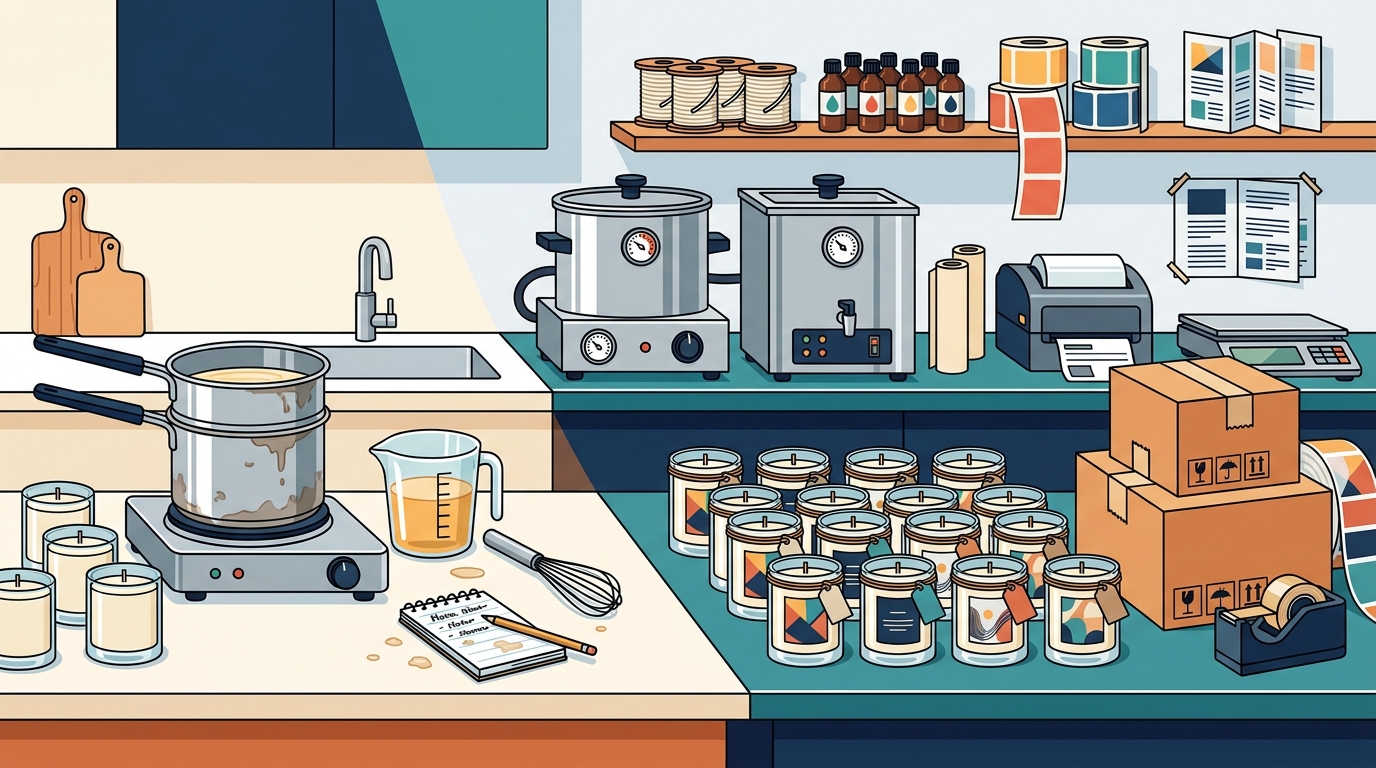
Recommended Supplies for the Testing Phase
You do not need to invest thousands of dollars at this stage. A focused testing budget of roughly $175 to $250 covers wax, wicks, fragrance oils, vessels, tools, and labels. Makesy offers curated DIY kits and candle making starter supplies that bundle premium-grade wax, wicks, fragrance oils, and vessels—ideal for structured experimentation without overbuying.
Phase 2 — Define Your Niche and Brand Identity
Why Niching Down Matters
The candle market is competitive, so standing out is essential. Rather than making generic candles, choose a niche that aligns with your personal style, values, and target audience. Popular niches include:
- Luxury & minimalist: High-end packaging, unique fragrance blends, neutral color palettes.
- Eco-friendly & sustainable: Plant-based waxes, recyclable vessels, clean-burning formulations.
- Wellness & intention: Candles designed around mood—relaxation, focus, energy—with functional fragrance technology.
- Decorative & sculptural: Pillar candles, shaped molds, statement pieces for home décor.
- Gift-forward: Curated sets, seasonal collections, and personalized options.
Branding Beyond the Logo
Your brand is much more than a name and a logo. It encompasses your mission statement, visual identity, packaging experience, and the story you tell. Customers in 2025 love brands that share a genuine story—your why—on their website and social channels.
Key branding elements to develop early:
- Mission statement: Clarify what you make, who it is for, and the values driving your business.
- Visual identity: Color palette, typography, photography style. Tools like Canva make professional-looking label and packaging design accessible to beginners.
- Packaging experience: Thoughtful packaging increases perceived value and helps justify higher price points. Even simple kraft boxes with a branded sticker and a handwritten note can dramatically boost repeat business.
Makesy supports brand-building with its packaging collection and customizable labels, letting you create a cohesive, premium look from day one. The makesy made better™ badge is also a free asset for makers who prioritize clean, eco-friendly ingredients—a powerful trust signal on your website and product pages.
Phase 3 — Handle the Legal and Financial Foundations
Business Structure
Registering as a legal business entity protects you and builds credibility. Common options include:
- Sole proprietorship: Simplest to set up, but no separation between personal and business assets.
- LLC (Limited Liability Company): Provides personal liability protection. Because candles involve fire risk and potential product liability, many entrepreneurs choose an LLC for added safety. Filing costs range from $50 to $500 depending on your state.
You will also need a free Employer Identification Number (EIN) from the IRS website for tax purposes and business banking.
Licenses, Permits, and Labeling
While there is no specific federal candle-making license, your labels must comply with the Fair Packaging and Labeling Act enforced by the FTC. Labels must state the product identity, net quantity, and your business name and address. Additionally, register for a state sales tax permit and check with your city or county for a general business license (typically $50 to $100). If you operate from home, a Home Occupation Permit may be required.
Always include burn instructions and safety warnings on every candle label. Safety compliance is non-negotiable and protects both your customers and your business longevity.
Insurance
Product liability insurance protects you if a candle malfunctions and causes a fire or property damage. A combined general and product liability policy typically costs between $400 and $1,500 per year, with $1 million in coverage as a standard starting point. Providers like Next Insurance, Hiscox, and the Handcrafted Soap & Cosmetic Guild (HSCG) group rates are popular choices among artisan makers.
Phase 4 — Price Your Candles for Profit
One of the most common mistakes new candle sellers make is underpricing. A reliable pricing formula is:
(Material Cost + Labor + Overhead) × 2 to 3 = Retail Price
Many handmade candles cost between $3 and $8 to produce and can sell for $15 to $40 or more, depending on your market positioning. Candles benefit from repeat purchases, gift-buying behavior, and seasonal demand spikes, but profitability requires careful pricing and consistent quality.
Makesy's pricing confidence tools and business education resources within its Business Hub help makers calculate Cost of Goods Sold (COGS) accurately and price with confidence.
Startup Cost Overview
| Category | Estimated Range |
|---|---|
| Testing supplies (wax, wicks, fragrance, vessels) | $175–$250 |
| Website & legal setup (Shopify/Etsy, domain, registration, insurance) | ~$200 |
| Initial inventory & packaging | $350–$500 |
| Branding (logo, Canva Pro, labels) | $100–$200 |
| Total estimated startup | $1,000–$1,500 |
These figures reflect a lean, intentional launch. Some makers spend $5,000 or more by testing dozens of wax types and iterating their brand, but that is not required to get started.
Phase 5 — Choose Your Sales Channels
To maximize revenue, combine online and offline selling strategies:
Online Channels
- Etsy: Great for beginners to tap into an existing marketplace of handmade buyers. Listing fees are $0.20 per item per four months, plus transaction fees.
- Shopify: The gold standard for building a scalable e-commerce brand (~$39/month). Ideal once you want full control over your customer experience.
- Amazon Handmade: Access to a massive customer base, though competition is fierce.
Offline Channels
- Farmers markets & craft fairs: Excellent for networking, getting direct feedback, and building a local following. Note: most events require proof of vendor insurance.
- Boutiques & gift shops: Wholesale or consignment deals can significantly expand your reach.
- Subscription boxes: Partnering with curated subscription services exposes your candles to new audiences at scale.
Marketing Essentials
Video content performs exceptionally well for candle brands—short-form clips on TikTok and Instagram Reels showing unboxing, pouring, and lifestyle shots drive discovery. Encourage customers to share photos and reviews as user-generated content, which builds social proof organically. SEO matters too: optimize product listings with keywords like “handmade soy candles” or “eco-friendly candles” to attract organic search traffic.
Phase 6 — Scale Sustainably With Wholesale Supplies
Once your candles are selling consistently, reducing per-unit costs becomes critical. Transitioning from small craft-store purchases to wholesale and bulk suppliers can dramatically improve your margins.
Makesy carries over 200 candle making products trusted by more than one million makers worldwide, with same-day fulfillment and free shipping on qualifying orders. Their wholesale program offers bulk discounts on jars, fragrance oils, wicks, wax varieties, and packaging—with flexible ordering options and dedicated support designed for growing businesses.
Additional scaling strategies:
- Automate repetitive tasks: Bulk pouring, label printing, and order management software reduce time per unit.
- Track profit per SKU: If you cannot measure which products are most profitable, you do not know what to scale.
- Reinvest revenue: Upgrade equipment (reliable gram-accurate scales, professional melters) and invest in professional product photography only after validating demand.
Essential Resource Toolkit
| Resource | What It Helps With |
|---|---|
| Makesy DIY & Starter Kits | Structured experimentation with curated supplies |
| Makesy Fragrance Oil Library | Developing signature scent profiles |
| Makesy Tools & Equipment | Scales, melters, molds, heat guns for production |
| Makesy Business Hub | Business education, pricing guides, community |
| National Candle Association | Safety standards, industry data, labeling guidance |
| ASTM F2417 / CPSC Guidelines | Candle safety and testing standards |
| Canva | DIY label design, social media templates |
| Next Insurance / Hiscox / HSCG | Product liability and general liability coverage |
| Google Trends & Pinterest Trends | Niche validation and scent trend research |
| Shopify / Etsy | E-commerce storefronts and marketplace access |
Key Takeaways
- Master your craft before launching—use frameworks like the 84 Candle Rule to build skill and gather feedback without the pressure of sales.
- Start lean. Most serious candle businesses launch for $1,000 to $1,500 with intentional spending on testing, branding, and initial inventory.
- Register legally, get liability insurance, and comply with FTC labeling rules from day one.
- Niche down to stand out in a saturated market—luxury, eco-friendly, wellness, or decorative.
- Price using a formula that accounts for materials, labor, and overhead—aim for 2× to 3× markup.
- Combine online and offline sales channels for maximum reach.
- Scale gradually by switching to wholesale suppliers like makesy for bulk pricing and consistent quality.
Frequently Asked Questions
How much does it cost to start a candle business from home?
Most home-based candle businesses can get started for around $1,000 to $1,500. This covers testing supplies, basic branding, initial inventory, legal registration, and essential tools. You can start even leaner by using DIY kits, though scaling will require additional investment.
Do I need a license or certification to sell candles?
There is no specific federal candle-making license in the United States. However, your labels must comply with the Fair Packaging and Labeling Act, you will need a state sales tax permit, and most localities require a general business license. Certifications are not mandatory but can boost credibility.
What is the best business structure for a candle business?
Many candle entrepreneurs choose an LLC because candles involve fire risk and potential product liability. An LLC provides personal asset protection. Sole proprietorships are simpler but offer no liability separation.
Where should I sell my candles first?
Etsy is an excellent starting point because it gives you access to an established audience of handmade buyers with minimal upfront cost. Farmers markets and craft fairs are ideal for in-person feedback. As you grow, a dedicated Shopify store gives you full brand control.
How do I price handmade candles profitably?
Use the formula: (Material Cost + Labor + Overhead) × 2 to 3 = Retail Price. Many handmade candles cost $3 to $8 to produce and sell for $15 to $40+. Always research competitor pricing and factor in platform fees, shipping, and packaging costs.
What supplies do I need to start making candles for sale?
At minimum you need wax (soy, coconut, or blends), wicks (cotton or wood), fragrance oils, containers or molds, a pouring pot or melter, a thermometer, a scale, and labels. Makesy offers complete starter kits that bundle these essentials together with tutorials to guide you.