

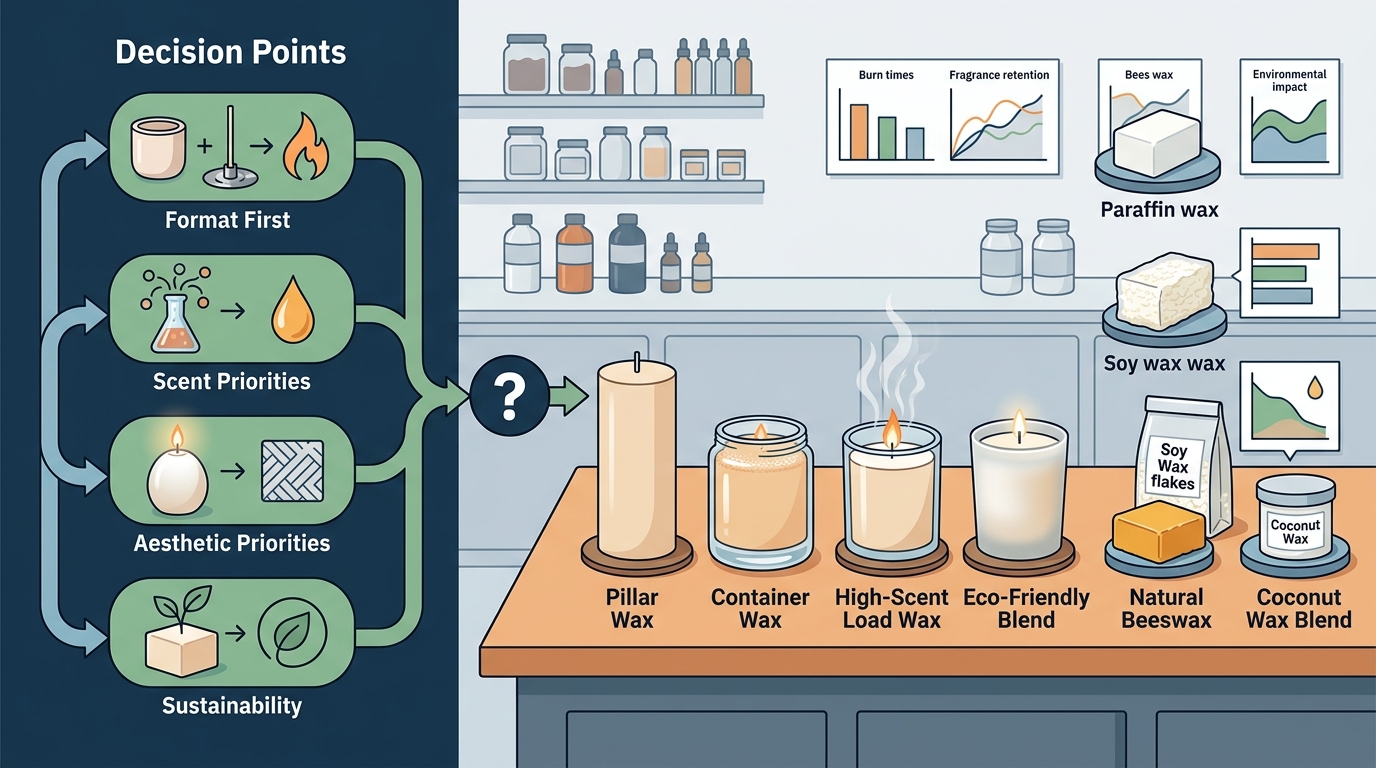
Picking the right wax is the single most consequential decision you will make before you ever strike a match. The wax you select determines burn time, scent throw, visual finish, and even the values your brand communicates to customers. Instead of listing waxes alphabetically and hoping you figure it out, this guide walks you through a practical decision framework—start with your project format, layer in your scent and aesthetic priorities, weigh sustainability, and land on the perfect wax (or blend) for your next pour.
Why Wax Choice Matters More Than You Think
Wax is not just fuel. It is the structural medium that holds your wick, fragrance oil, and dye together and controls how all three perform once the candle is lit. The type of wax you use affects how cleanly a candle burns, how strong the scent is, and how eco-friendly the finished product is. A gorgeous vessel and a premium fragrance oil will under-deliver if they are paired with the wrong wax, so treat this choice as the foundation of every project.
Step 1 — Define Your Candle Format
Before comparing wax types, answer one question: What kind of candle are you making? Format narrows the field immediately.
Container Candles (Jars, Tins, Tumblers)
Because container candles do not need to hold their own shape, you can use softer waxes such as soy, coconut blends, and coconut-apricot blends. Soy wax and coconut-soy blends are the most popular choices among container candle makers for their smooth finish and clean burn. At makesy, the Virgin Coconut Soy blend is the number-one selling wax precisely because it delivers exceptional adhesion, a creamy surface, and outstanding hot and cold scent throw in jars of every size.
Pillar and Molded Candles
Freestanding candles need a harder wax that holds its shape at room temperature. The best waxes for pillar candles are paraffin, beeswax, and palm wax. Beeswax is a hard wax with a high melting point, which means it takes longer to melt but releases from molds cleanly. If you want a natural, petroleum-free pillar candle, beeswax is the go-to material. Palm wax is another hard option that creates unique crystal-like patterns on the surface once it solidifies.
Votives and Tarts / Wax Melts
Votives sit in small holders and can use a wide range of waxes—soy, palm, beeswax, wax blends, and paraffin all work. For wax melts specifically, blends that carry a high fragrance load excel. A coconut-soy-sunflower blend, for example, can hold a surprisingly high fragrance load, making it ideal for flameless wax-melt warmers.
Step 2 — Prioritize Your Performance Goals
Once you know your format, rank the following factors from most to least important. Your ranking points you toward specific wax families.
Scent Throw
If maximum fragrance is the top priority, coconut wax and paraffin wax are the strongest performers. Paraffin has a high fragrance load, and coconut wax frequently rivals it in both cold and hot scent throw. Coconut-soy blends (sometimes called coco-soy) let you capture most of that scent power while staying 100-percent plant-based.
Burn Time
Beeswax burns the longest, followed by coconut and soy. Soy candles burn slower and cooler than paraffin, which extends the life of each candle and gives customers more hours of enjoyment per purchase. If you are pricing by the hour of burn, a soy or beeswax base will support a higher perceived value.
Clean Burn and Low Soot
Soy wax, coconut wax, and beeswax are all considered clean-burning options. Soy wax is a plant-based wax made from hydrogenated soybean oil and is popular in eco-friendly candle lines because it produces low soot and is biodegradable. Beeswax candles are widely considered the cleanest-burning candles available and produce virtually no soot or smoke when paired with a properly sized wick.
Visual Finish
Paraffin wax delivers a sleek, shiny finish and does not frost like soy wax. Soy wax can produce frosting—a white crystalline layer on the surface—that is harmless but may affect the aesthetic. Coconut wax and coconut-apricot blends offer a luxurious, smooth, creamy appearance that many boutique brands prefer. If you want a glossy, polished look without frosting, makesy's Deluxe Satin Soy Wax blends polar and nonpolar molecules for a balanced base with a glossy finish.
Step 3 — Factor in Sustainability and Values
For many makers—especially those building a brand—ingredient sourcing is a marketing pillar, not an afterthought.
- Soy wax — Renewable, biodegradable, vegan. A top pick for eco-conscious brands.
- Coconut wax — Highly sustainable, biodegradable, vegan. Often blended because pure coconut wax is rarely sold on its own due to its very soft texture.
- Beeswax — Natural and chemical-free, but not vegan. Supports beekeepers and pollinators.
- Paraffin wax — A petroleum byproduct. Affordable and versatile, but not biodegradable and not considered eco-friendly by most consumers.
- Palm wax — Plant-derived, but carries deforestation concerns unless certified sustainable.
makesy's Made Better™ certification badge is designed for makers who prioritize clean, earth-conscious ingredients. If sustainability is core to your brand story, choosing a plant-based wax—soy, coconut, or a blend of both—aligns with that certification and resonates with today's conscious consumers.
Step 4 — Understand Popular Wax Blends
Single-origin waxes have trade-offs. Blending waxes lets you combine the best qualities of each.
| Blend | Key Benefit | Best For |
|---|---|---|
| Coconut-Soy (e.g., Virgin Coconut Soy) | Excellent scent throw + creamy texture + clean burn | Container candles, luxury brands |
| Coconut-Apricot (e.g., Coco Apricot Crème) | Single-pour ease, smooth tops, strong adhesion | Container candles, beginners |
| Soy-Paraffin (e.g., Deluxe Satin Soy) | Enhanced hot throw + glossy finish at lower cost | High-volume production, tarts |
| Beeswax-Paraffin | Hard structure + cost balance | Pillar and taper candles |
| Coconut-Soy-Sunflower | Ultra-high fragrance load | Wax melts |
Blends are also engineered to prevent common issues such as frosting and tunneling. A carefully crafted mixture can deliver reliable performance and a longer, uniform burn, which is critical when you are selling to customers who expect consistency.
Step 5 — Match Wax to Wick
Choosing the right wax is only half the equation. Regardless of the wax you choose, wick size and type, fragrance oils, and dyes all play key roles in candle performance. A wax that burns beautifully in testing can tunnel or mushroom with the wrong wick. General rules of thumb:
- Soy and coconut blends — Cotton or wooden wicks both work well. Wooden wicks add a crackling aesthetic that pairs naturally with the creamy look of coconut-soy wax.
- Paraffin — Zinc-core or cotton wicks are common. Paraffin's higher melt pool temperature gives you wider wick options.
- Beeswax — Requires a thicker wick due to its high melting point and density.
Always test every wax-wick-fragrance combination. makesy offers a candle wick size guide and a candle testing app to help you dial in the perfect pairing before you commit to a production run.
Quick-Reference Decision Cheat Sheet
| Your Priority | Recommended Wax |
|---|---|
| Strongest scent throw | Coconut-soy blend or paraffin |
| Longest burn time | Beeswax or soy |
| Eco-friendly + vegan | Soy or coconut-soy blend |
| Budget-friendly bulk production | Soy-paraffin blend (e.g., Deluxe Satin Soy) |
| Luxury boutique aesthetic | Coconut-apricot blend (e.g., Coco Apricot Crème) |
| Pillar or molded candles | Beeswax or palm wax |
| Beginner-friendly, single-pour | Coco Apricot Crème or Virgin Coconut Soy |
Key Takeaways
- Start with format. Container, pillar, or melt? This eliminates wax types that will not work structurally.
- Rank your performance goals. Scent throw, burn time, clean burn, and aesthetics each point toward different waxes.
- Blends solve trade-offs. Coconut-soy and coconut-apricot blends are popular because they combine scent strength, clean burn, and visual appeal in one pour.
- Test before you commit. Every wax-wick-fragrance combination behaves differently. Small-batch testing is non-negotiable.
- Align wax with brand values. If sustainability is part of your story, choose plant-based waxes and consider earning a Made Better™ badge.
Frequently Asked Questions
What is the best wax for beginners?
Soy wax flakes are the most beginner-friendly option because they melt quickly, clean up with soap and water, and are forgiving if you make temperature mistakes. A coconut-soy or coconut-apricot blend is also excellent for beginners because many are formulated for a single-pour process with smooth, consistent tops.
Can I mix different waxes together?
Yes. Many candle makers experiment with blends to balance cost, fragrance, and appearance. Common combinations include coconut-soy, soy-paraffin, and beeswax-paraffin. Pre-formulated blends from suppliers like makesy take the guesswork out of ratios and compatibility.
Is soy wax better than paraffin wax?
It depends on your priorities. Soy wax is renewable, biodegradable, and burns longer. Paraffin wax is more affordable and delivers a stronger hot throw with a glossy finish. Neither is universally better—the right choice depends on your project goals, brand values, and target customer.
What wax has the strongest scent throw?
Paraffin wax has traditionally offered the strongest hot throw. However, coconut wax frequently rivals paraffin in both cold and hot scent throw, making coconut-soy blends a popular choice for makers who want powerful fragrance with a clean-burning, plant-based base.
Why does my soy candle have white spots on top?
Those white spots are called frosting—a natural crystallization of soy wax that is completely harmless and does not affect burn performance. You can minimize frosting by pouring at a slightly higher temperature, warming your vessels before pouring, or switching to a coconut-soy blend that resists frosting.
What wax should I use for pillar candles?
Pillar candles need a hard wax that holds its shape. Beeswax, palm wax, and certain paraffin formulations are the best options. Soft waxes like pure soy or coconut-apricot blends are designed for containers and will not hold up as freestanding pillars.