
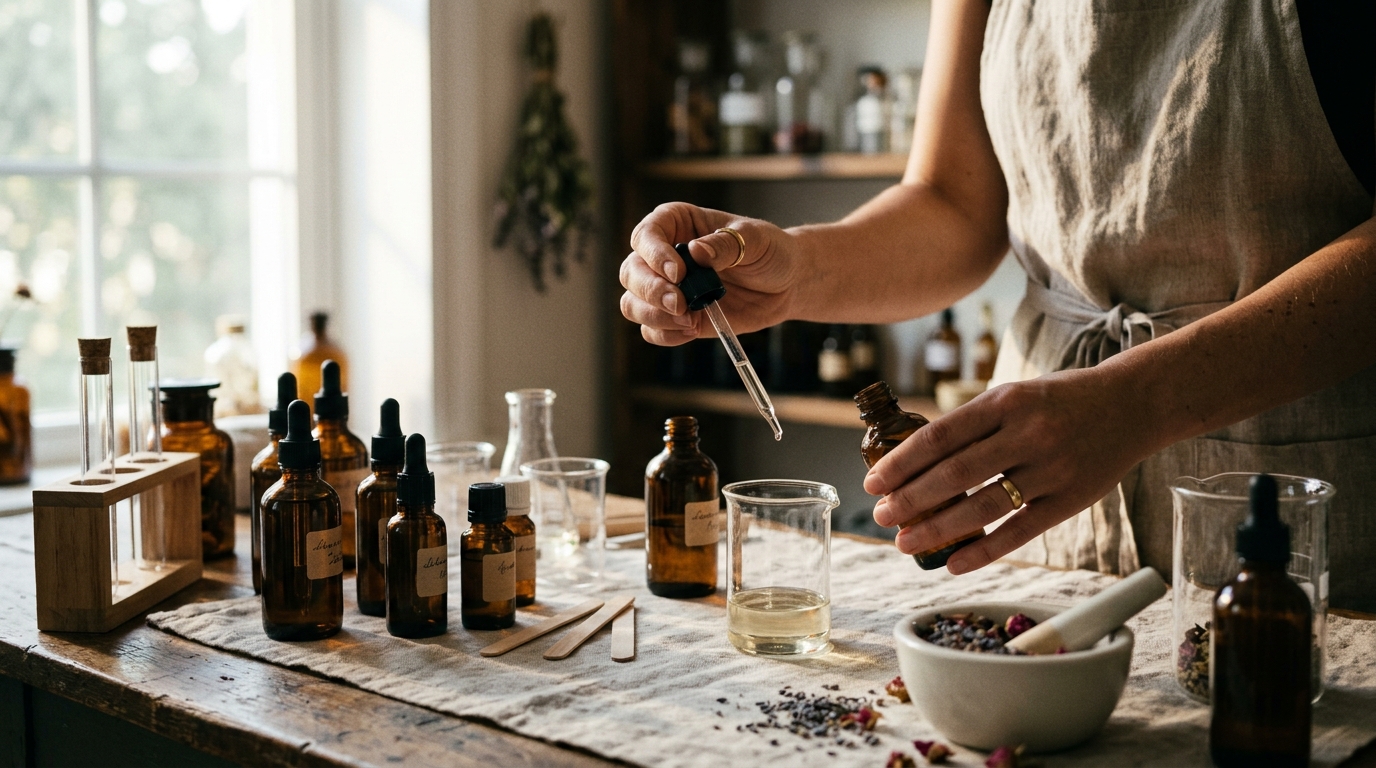
Creating custom fragrance blends allows you to craft unique scents for candles, soaps, and lotions that stand out in a crowded market. According to industry data, the global fragrance market is projected to reach significant growth by 2026, driven by consumer demand for personalized and artisanal products. This guide will walk you through the essential steps of blending, from selecting your base notes to calculating the correct fragrance load for your specific medium.
Understanding Fragrance Notes
Before you mix any oils, you must understand the structure of a fragrance. A professional blend is built on three distinct layers known as notes. These notes evaporate at different rates, creating a dynamic scent profile that evolves over time.
Top notes are the first scents you perceive. They are light, fresh, and evaporate quickly. Common top notes include citrus oils like lemon, bergamot, and grapefruit. These provide the initial impression of your blend.
Heart notes form the core of the fragrance. They emerge after the top notes fade and last longer. Floral and spicy scents often dominate this layer. Examples include lavender, rose, and cinnamon.
Base notes are the foundation. They are heavy, rich, and long-lasting. Base notes anchor the lighter scents and provide depth. Woodsy and musky scents like sandalwood, vanilla, and patchouli are typical base notes.
When you visit Makesy's fragrance collection, you will find a wide array of these oils. Understanding how they interact is the first step to mastery. You can explore essential oils for natural alternatives or synthetic fragrance oils for intense, consistent scents.
Selecting Your Medium
Not all fragrance oils are created equal. The medium you choose dictates the type of oil you need. Using the wrong oil can result in poor scent throw or safety hazards.
Candle wax requires fragrance oils specifically designed for wax. These oils are formulated to bind with wax molecules, ensuring the scent disperses evenly when burned. You can find specialized wax supplies at Makesy to ensure compatibility.
Soap demands different considerations. Cold process soap can be tricky with certain oils, as some may accelerate the trace. It is crucial to use soap-safe fragrance oils that have been tested for stability in alkaline environments.
Lotions and body care require skin-safe fragrance oils. These must be diluted properly and tested for skin sensitivity. Always check the help center for specific safety guidelines regarding skin contact products.
Calculating Fragrance Load
Fragrance load is the percentage of fragrance oil relative to the weight of your base material. Getting this right is critical for performance and safety.
For wax, the maximum fragrance load varies by wax type. Soy wax typically holds between 6% and 10% fragrance. Paraffin wax can hold up to 12%. Exceeding the recommended load can cause the wax to weep or fail to burn properly.
For soap, the fragrance load is usually between 3% and 6%. Too much oil can cause the soap to soften or separate. Always calculate your load based on the weight of the oils in your recipe, not just the water.
For lotions, the load is typically 1% to 3%. Higher concentrations can irritate the skin. Use a body care additive if needed to stabilize the scent in the emulsion.
At Makesy, you can calculate your needs precisely by entering your batch size. This ensures you order the correct amount of oil without waste.
Blending Techniques
Blending is both an art and a science. Start with a clean workspace and precise tools. A digital scale is non-negotiable for accuracy.
Step 1: Plan your blend. Sketch out your note structure. Decide on the ratio of top, heart, and base notes. A common starting ratio is 30% top, 50% heart, and 20% base.
Step 2: Mix the base notes. Combine your base oils first. They are the anchor. Let them sit for a few minutes to allow the molecules to interact.
Step 3: Add heart notes. Introduce your heart oils gradually. Stir gently to avoid introducing air bubbles, which can affect the final product.
Step 4: Top notes last. Add your top notes last. They are the most volatile. Once mixed, let the blend rest for 24 to 48 hours. This process, known as "maceration," allows the scents to meld together.
For advanced blending, consider using custom fragrance services if you have a specific vision but lack the raw materials. Makesy offers MakerPro resources for professional insights.
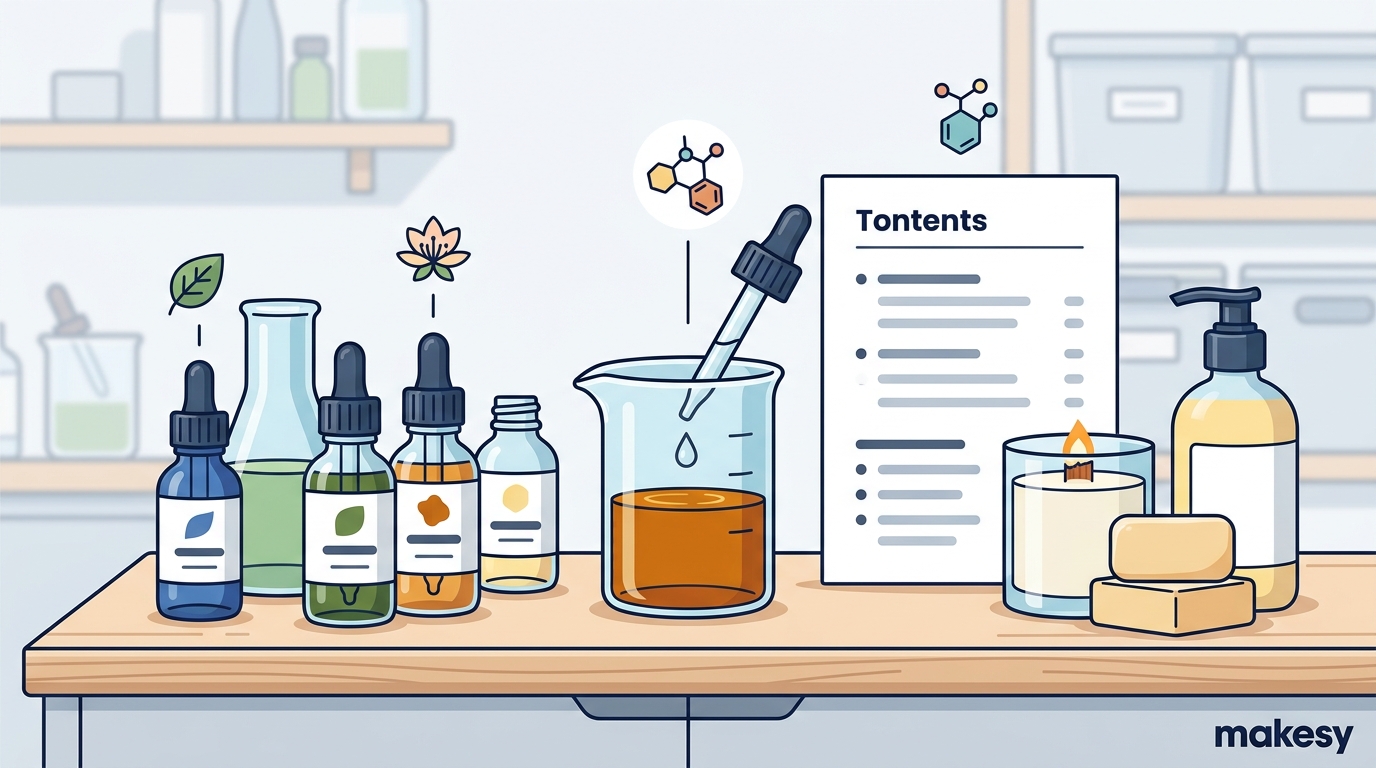
Safety and Testing
Safety is paramount in fragrance creation. Always work in a well-ventilated area. Wear gloves and eye protection when handling concentrated oils.
Hot throw testing is essential for candles. Burn a small sample of your finished candle to assess the scent throw. Adjust your blend if the scent is too weak or overpowering.
Cold throw testing evaluates the scent when the product is unlit. This is crucial for soaps and lotions. Ensure the scent is detectable and pleasant without burning.
Always check the candle safety guidelines and skin care safety data sheets for each oil. Some oils have IFRA restrictions that limit their usage levels.
For shipping and handling, Makesy's shipping policies ensure your oils arrive safely. Consider joining the Ocean membership for faster delivery options.
Key Takeaways
- Understand the three note layers: top, heart, and base, to create balanced blends.
- Use fragrance oils specifically formulated for your medium, whether wax, soap, or lotion.
- Calculate fragrance load precisely, typically 6-10% for wax and 3-6% for soap.
- Allow blends to rest for 24-48 hours to let the scents meld together.
- Always test your final product for both hot and cold throw before full production.
- Follow IFRA guidelines and safety data sheets for every oil used.
- Utilize Makesy's extensive catalog for high-quality, reliable ingredients.
Frequently Asked Questions
Can I mix essential oils and fragrance oils?
Yes, you can mix them, but be aware that essential oils may alter the scent profile and performance of synthetic fragrance oils. Test small batches first to ensure compatibility and desired scent strength.
How do I fix a candle that has no scent throw?
Ensure you are using the correct fragrance load for your wax type. Also, verify that the fragrance oil is compatible with your specific wax. Adding a scent enhancer might help, but proper formulation is key.
What is the shelf life of fragrance oils?
Most fragrance oils have a shelf life of 1 to 2 years if stored in a cool, dark place. Oxidation can degrade the scent over time. Always check the fragrance storage guidelines for specific products.
Do I need a perfumer's alcohol for blending?
For candles and soaps, no. Perfumer's alcohol is used for creating perfumes and sprays. For wax-based products, simply mixing the oils is sufficient. For spray products, you will need alcohol and a solubilizer.
How much fragrance oil do I need for a 1 lb candle?
For a 1 lb (16 oz) candle, you would typically use 1 to 1.6 ounces of fragrance oil, depending on the wax's maximum load. Calculate based on the percentage recommended by the wax manufacturer.
Can I use food-grade oils in candles?
No, food-grade oils are not suitable for candles. They do not burn cleanly and can be a fire hazard. Always use candle-specific fragrance oils.
Where can I find help with my blending?
Makesy offers a comprehensive help center with articles on wicks, wax, and fragrance. You can also contact their support team for personalized advice.
Start Blending
Creating custom fragrance blends is a rewarding journey that combines creativity with technical precision. By understanding notes, selecting the right medium, and prioritizing safety, you can produce high-quality products that resonate with customers. Start your journey with Makesy and explore our vast collection of fragrance oils, waxes, and wicks. Visit checkout to begin your order today and elevate your homemade products.