
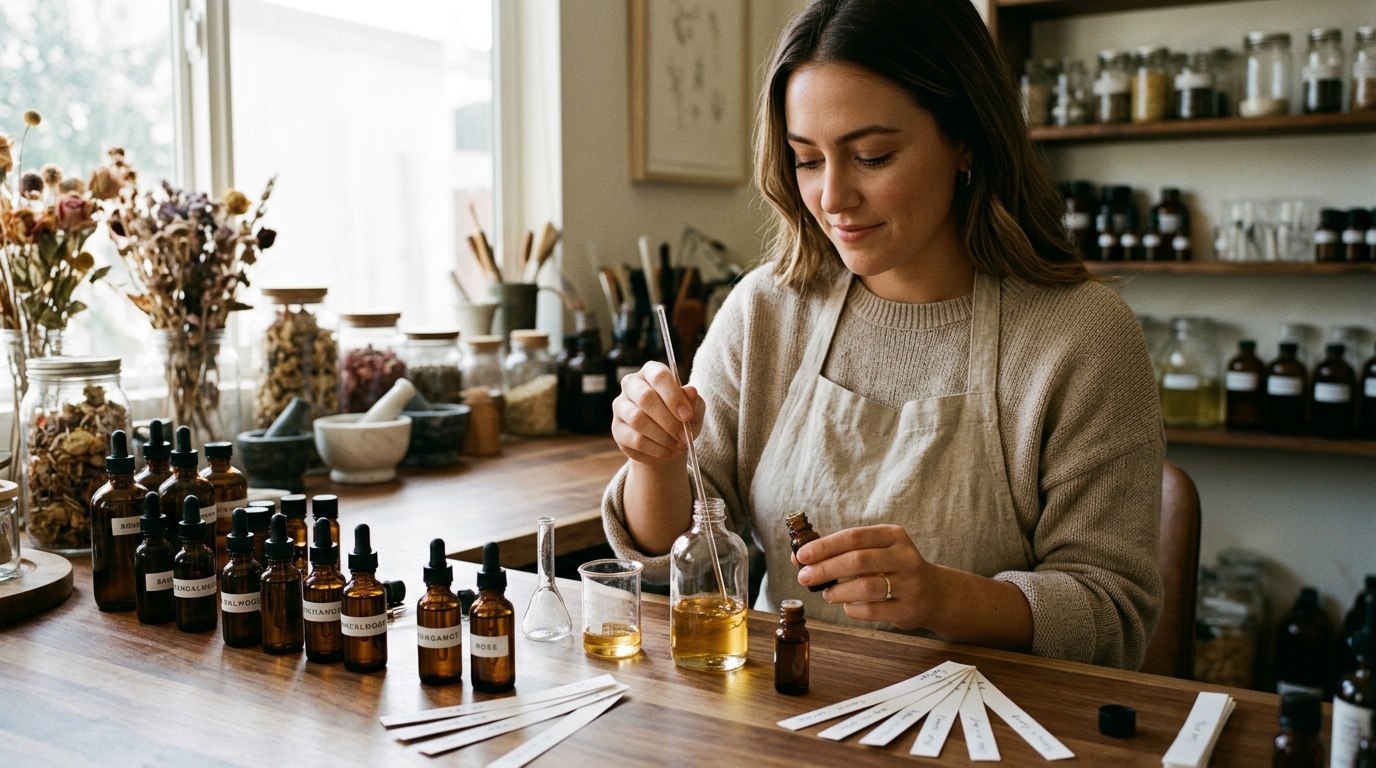
Creating your own custom fragrance blends is one of the most rewarding skills a DIY maker can develop. Whether you are crafting candles, soaps, skincare, or perfumes, a signature scent sets your products apart and gives customers a reason to come back. The process is equal parts art and science: you need to understand fragrance notes, choose quality oils, and test methodically. In this guide you will learn the fundamentals of scent layering, practical blending techniques, and tips for scaling your creations from kitchen experiments to sellable products.
Understanding Fragrance Notes
A fragrance note is a distinct layer of scent within a blend. In the world of perfumery, scents are categorized into three main layers: top, middle, and base notes. These layers form the foundation of every fragrance, influencing how a scent unfolds over time.
Top Notes
Top notes are the first impression of your blend. They are bright, airy, and volatile, typically lasting 5 to 30 minutes before fading. Common examples include bergamot, lemon, eucalyptus, and peppermint.
Middle (Heart) Notes
Middle notes are the core personality of a fragrance, emerging after the top notes dissipate. They often last 20 minutes to several hours and make up roughly 40 to 80 percent of the overall scent profile. Lavender, rose, jasmine, and cinnamon are popular choices.
Base Notes
Base notes provide depth, warmth, and longevity. They are the foundation upon which a fragrance is built, lingering for hours or even days on fabric. Vanilla, sandalwood, amber, musk, and patchouli are classic base note ingredients.
Choosing Your Oils: Fragrance Oils vs. Essential Oils
A fragrance oil is a synthetically crafted aromatic compound designed to emulate natural scents with robust, consistent performance. An essential oil is a 100% pure, plant-derived extract that retains the natural aromatic properties of its source. Both have a place in custom blending, and the right choice depends on your product type and goals.
Makesy offers an extensive selection of made better™ fragrance oils, including fine fragrance, certified natural, and functional options. For pure botanical scents, explore the 100% pure essential oils collection, ideal for candle making, soap making, bath and body, and skincare applications.
| Feature | Fragrance Oils | Essential Oils |
|---|---|---|
| Source | Synthetic and/or natural blends | 100% plant-derived |
| Scent Consistency | Highly consistent batch to batch | Can vary by harvest |
| Scent Range | Virtually unlimited | Limited to botanical sources |
| Best For | Candles, soaps, perfumes, body care | Aromatherapy, skincare, natural products |
| Price Point | Generally more affordable | Varies; some are costly |
Essential Tools for Fragrance Blending
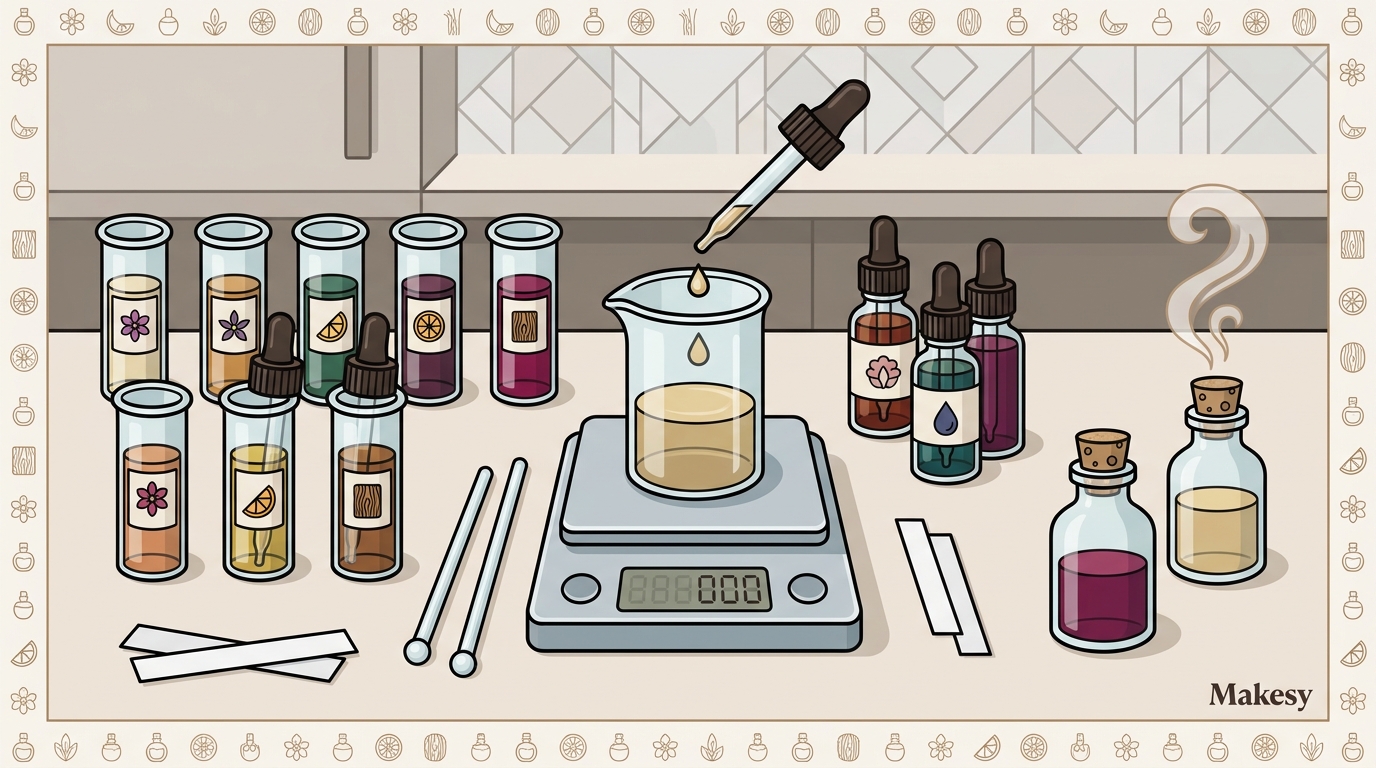
Precision matters when you are creating repeatable blends. Use tools like precision droppers, scent blotters, and a digital scale that reads to 0.1 grams. A set of small glass beakers or vials (5 to 15 ml) lets you mix test batches without wasting materials.
Keep a dedicated fragrance journal. Documenting your trials and successes allows you to replicate your favorite scents and refine others over time. Record every ratio, ingredient name, and curing observation so you can scale confidently later.
Step-by-Step Blending Process
1. Define Your Scent Profile
Start by deciding the mood or setting for your product. A relaxing lavender might be perfect for bedroom candles, while a vibrant citrus could energize a living space. Write down the emotion you want to evoke before selecting any oils.
2. Select One Oil From Each Note Category
Choose a top, middle, and base note that complement each other. A proven beginner ratio is 30% top notes, 50% middle notes, and 20% base notes. This structure gives your blend an inviting opening, a full-bodied heart, and lasting depth.
3. Mix Small and Evaluate
Experiment with small quantities first to refine the scent without wasting materials. Blend 10 to 20 drops total in a glass vial, swirl gently, and test on a scent blotter. Wait at least 24 hours before making a final judgment, because fragrance blends change as the oils fuse together.
If you want a head start, fragrance sample kits from Makesy offer curated sets of oils that are designed to work well together. They are a great way to explore scent families before committing to full-size bottles.
Popular Fragrance Blend Combinations
The table below shows five crowd-pleasing blend ideas you can try right away. Adjust ratios to taste.
| Blend Name | Top Note | Middle Note | Base Note | Best For |
|---|---|---|---|---|
| Cozy Evening | Bergamot | Lavender | Vanilla | Candles, body lotion |
| Fresh Garden | Lemon | Rosemary | Cedarwood | Soap, room spray |
| Warm Spice | Orange | Cinnamon | Sandalwood | Candles, perfume |
| Floral Bliss | Grapefruit | Jasmine | Musk | Bath bombs, lotion |
| Tropical Escape | Coconut | Ylang Ylang | Amber | Soap, hair care |
For vanilla-forward blends, browse Makesy's vanilla fragrance oils. If you want to explore trending scent profiles, check the best-selling fragrance oils page for maker favorites.
Testing and Refining Your Blends
Always test how your fragrance oils interact with other ingredients, particularly with different wax types or soap bases, to ensure the stability and quality of your final product. A blend that smells perfect on a blotter may behave differently in soy wax versus a melt-and-pour soap base.
Allow your blends to mature. Good things take time, and fragrance blending is no exception. Candles typically need a cure time of one to two weeks for the oils to fully bind with the wax. Cold-process soaps may need four to six weeks. Record scent performance at each stage in your fragrance journal.
When you are ready to create a truly one-of-a-kind scent, Makesy even offers a customized fragrance oil service where the fragrance created for you belongs exclusively to you and will not be used for any other customer.
Key Takeaways
- Every great fragrance blend balances top, middle, and base notes for depth and longevity.
- Fragrance oils offer consistency and variety, while essential oils deliver pure botanical authenticity.
- Start with small test batches of 10 to 20 drops before scaling up.
- A beginner-friendly ratio is 30% top, 50% middle, and 20% base notes.
- Always test blends in your actual product medium (wax, soap base, lotion) since performance varies.
- Keep a detailed fragrance journal to track ratios, cure times, and scent evolution.
- Allow blends to mature for at least 24 to 48 hours before making final adjustments.
Frequently Asked Questions
What are fragrance oils?
Fragrance oils, also known as aromatic oils, are synthetically made to emulate natural scents. They provide robust, consistent aromas and are a popular choice for candles, soaps, and body care products.
Can I mix fragrance oils with essential oils?
Yes. Many makers blend fragrance oils and essential oils together to combine the consistency of synthetics with the therapeutic qualities of plant extracts. Always check usage rates for each oil to stay within safe limits.
How many fragrance oils should I combine in one blend?
Simplicity often leads to elegance. Start with two to four oils per blend. A few well-chosen oils can produce a more striking effect than an overly complex combination.
What is the fragrance pyramid?
The fragrance pyramid is a triangular structure comprising top notes, middle (heart) notes, and base notes. It helps makers and perfumers visualize how a scent unfolds over time, from the bright opening to the lingering finish.
How do I know the right fragrance load for my candles?
Most candle waxes perform best with a 6% to 12% fragrance load by weight. Usage amounts can vary based on your desired fragrance strength, wax type, and vessel size. Always consult the manufacturer's recommendations and the oil's IFRA certificate for safe maximum levels.
How long should I let my fragrance blend cure?
For candles, a cure time of one to two weeks is typical. Cold-process soap requires four to six weeks. Allow your blend to mature so the oils have time to fuse into a harmonious scent.
Where can I find fragrance oils for soap making?
Makesy carries a large collection of soap-safe fragrance oils in fruity, floral, woody, and gourmand scent families. Each product page notes whether the oil is suitable for soap applications.
Can I sell products made with custom fragrance blends?
Absolutely. Many small business owners create signature blends to differentiate their product lines. Make sure your blends comply with IFRA guidelines for the specific product category you are selling.
Get Started Today
Ready to create your first custom fragrance blend? Browse the full fragrance oil collection at Makesy to find your perfect top, middle, and base notes. With eco-friendly, made better™ ingredients and bulk pricing, you have everything you need to turn your scent ideas into standout homemade products.