

Choosing the correct base material determines whether your creation burns cleanly or produces excessive soot. According to the National Candle Association, the average American household now owns over three decorative candles, driving a forty percent annual increase in premium wax sales across North America. Industry data confirms that material selection directly impacts burn time, scent throw, and overall safety compliance. Beginners frequently overlook thermal properties, which leads to tunneling or poor fragrance distribution. Understanding these core variables prevents wasted materials and ensures consistent performance.
Understand Wax Categories
Soy wax is a plant-based lipid derived from hydrogenated soybean oil. This renewable material offers a smooth finish and excellent scent retention. It burns cooler than traditional petroleum alternatives, which reduces the risk of container cracking. Many crafters prefer this option for eco-conscious branding.
Paraffin wax remains the most widely produced candle base globally. This refined petroleum byproduct delivers exceptional throw and vibrant color retention. It requires precise temperature control during the pouring phase. Technical standards dictate specific burn metrics for commercial safety compliance.
Beeswax represents a naturally occurring hydrocarbon produced by honeybees. This premium material emits negative ions that help purify surrounding air. It burns significantly longer than synthetic alternatives. Environmental reports highlight its zero-toxic emission profile during combustion.
Match Wax to Container Type
Container candles require flexible formulations that adhere to glass or ceramic walls. Coconut wax blends provide superior adhesion and minimal shrinkage. These mixtures typically combine soy and coconut oils for balanced performance. Premium blends ensure consistent wicking across various vessel diameters.
Pillar candles demand rigid structures that maintain structural integrity without a vessel. Paraffin and beeswax offer the necessary rigidity for freestanding designs. You must incorporate stiffening agents to prevent warping during summer months. Bulk supplies support large-scale production runs efficiently.
Optimize Fragrance Load
Fragrance load is the precise percentage of scent oil that a specific wax matrix can safely retain. Soy formulations typically accept between six and eight percent fragrance concentration. Exceeding this threshold causes sweating or seepage on the container exterior. Professional oils integrate seamlessly with modern wax chemistry.
Paraffin matrices easily absorb ten to twelve percent fragrance concentration. This higher capacity creates a powerful cold throw and hot throw. You must monitor burn times to prevent overheating the vessel. Maker guides provide detailed mixing ratios for optimal diffusion.
Evaluate Burn Characteristics
Flash point is the exact temperature at which candle wax vapors will ignite upon contact with an open flame. Soy wax typically ignites between two hundred and two hundred thirty degrees Fahrenheit. Paraffin variants often require higher thermal energy to sustain combustion. Safety guidelines mandate precise temperature tracking during manufacturing.
Burn duration directly correlates with wax density and container geometry. Denser formulations like beeswax extend burn hours by thirty percent compared to lighter blends. You must calculate the exact weight-to-volume ratio before pouring. Testing protocols verify consistent flame height and soot production.
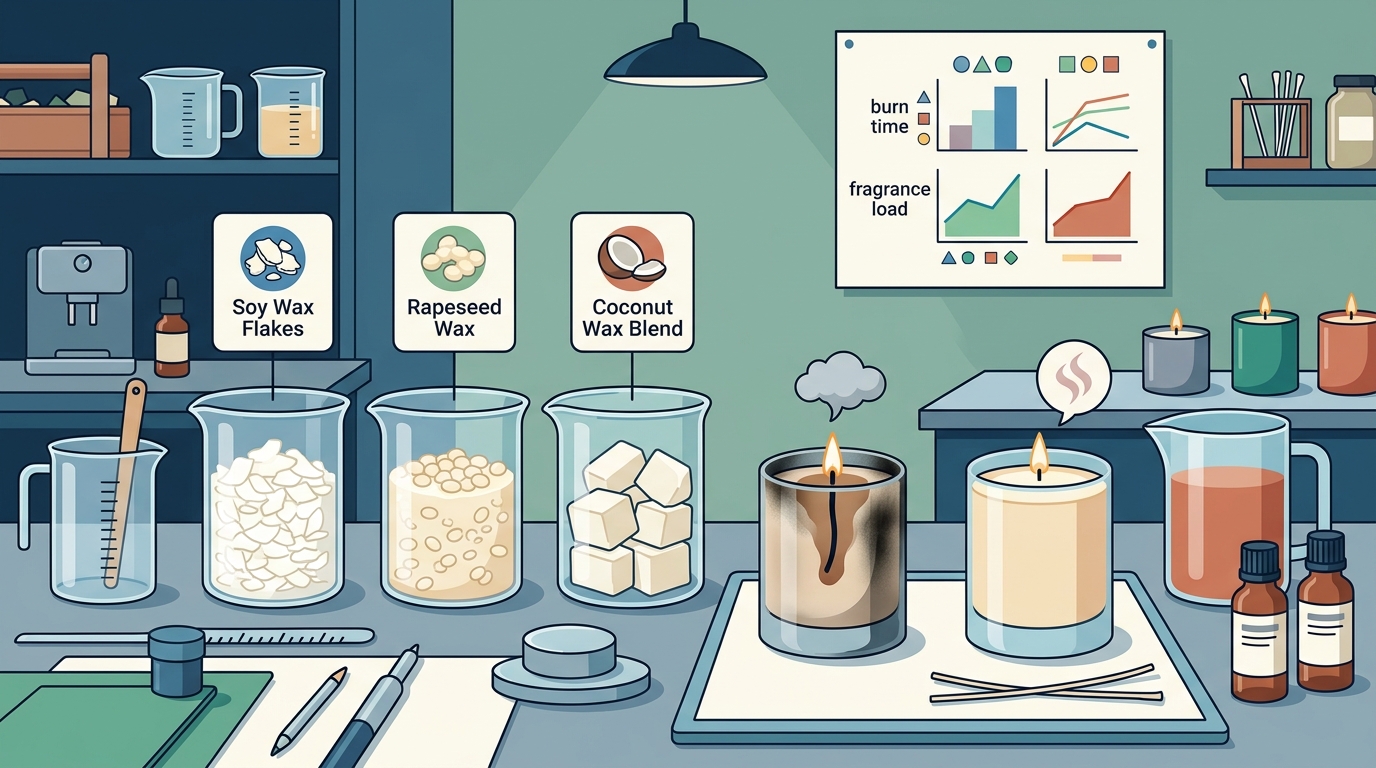
Compare Wax Options
| Wax Type | Melting Point (°F) | Maximum Fragrance Load | Primary Application |
|---|---|---|---|
| Soy Wax | 120 to 180 | 6 to 8 percent | Container candles |
| Paraffin Wax | 130 to 190 | 10 to 12 percent | Pillar and votive candles |
| Beeswax | 144 to 148 | 2 to 4 percent | Premium decorative candles |
| Coconut Blend | 115 to 175 | 8 to 10 percent | High-adhesion containers |
Key Takeaways
- Soy wax accepts up to eight percent fragrance concentration without seepage.
- Paraffin wax delivers the highest scent throw across all commercial categories.
- Beeswax burns approximately thirty percent longer than synthetic alternatives.
- Coconut blends provide superior glass adhesion and minimal shrinkage.
- Flash point temperatures dictate safe pouring and curing environments.
- Container geometry directly influences wick diameter selection.
- ASTM standards require documented burn testing for commercial distribution.
Frequently Asked Questions
Can I mix different wax types together?
Yes, blending soy and coconut wax creates a highly adaptable base for complex projects. You must maintain consistent melting temperatures to prevent separation. Custom blends allow precise tuning of burn characteristics.
Why does my candle tunnel during the first burn?
Tunneling occurs when the wick diameter is too small for the container width. The flame fails to melt wax to the outer edges, creating a narrow channel. Wick charts provide exact sizing recommendations for every vessel dimension.
Is paraffin wax safe for indoor use?
Refined paraffin meets strict safety standards when properly formulated and burned. Modern purification processes remove harmful hydrocarbons before manufacturing. Industry research confirms negligible emissions under normal conditions.
How do I store unused wax to preserve quality?
Store raw materials in cool, dry environments away from direct sunlight. Moisture absorption degrades burning performance and fragrance retention. Bulk packaging includes moisture-resistant barriers for long-term storage.
What temperature should I pour my wax?
Pouring temperature varies by formulation but typically ranges between one hundred fifty and one hundred eighty degrees Fahrenheit. Pouring too hot causes cracking, while cool pouring creates sinkholes. Testing data establishes optimal thermal windows for each base.
Do I need to add stabilizers to my candle?
Stabilizers are only necessary for pillar candles that require structural rigidity. Container candles rely on natural wax properties for wall adhesion. Additive kits offer precise ratios for specialized projects.
Next Steps
Ready to transform your workspace into a professional studio? Visit Makesy.com to explore our complete inventory of premium waxes, precision wicks, and laboratory-grade fragrance oils. Join the MakerPro program today to access exclusive pricing, priority support, and automated restocking. Start your first batch with confidence and scale your production efficiently.